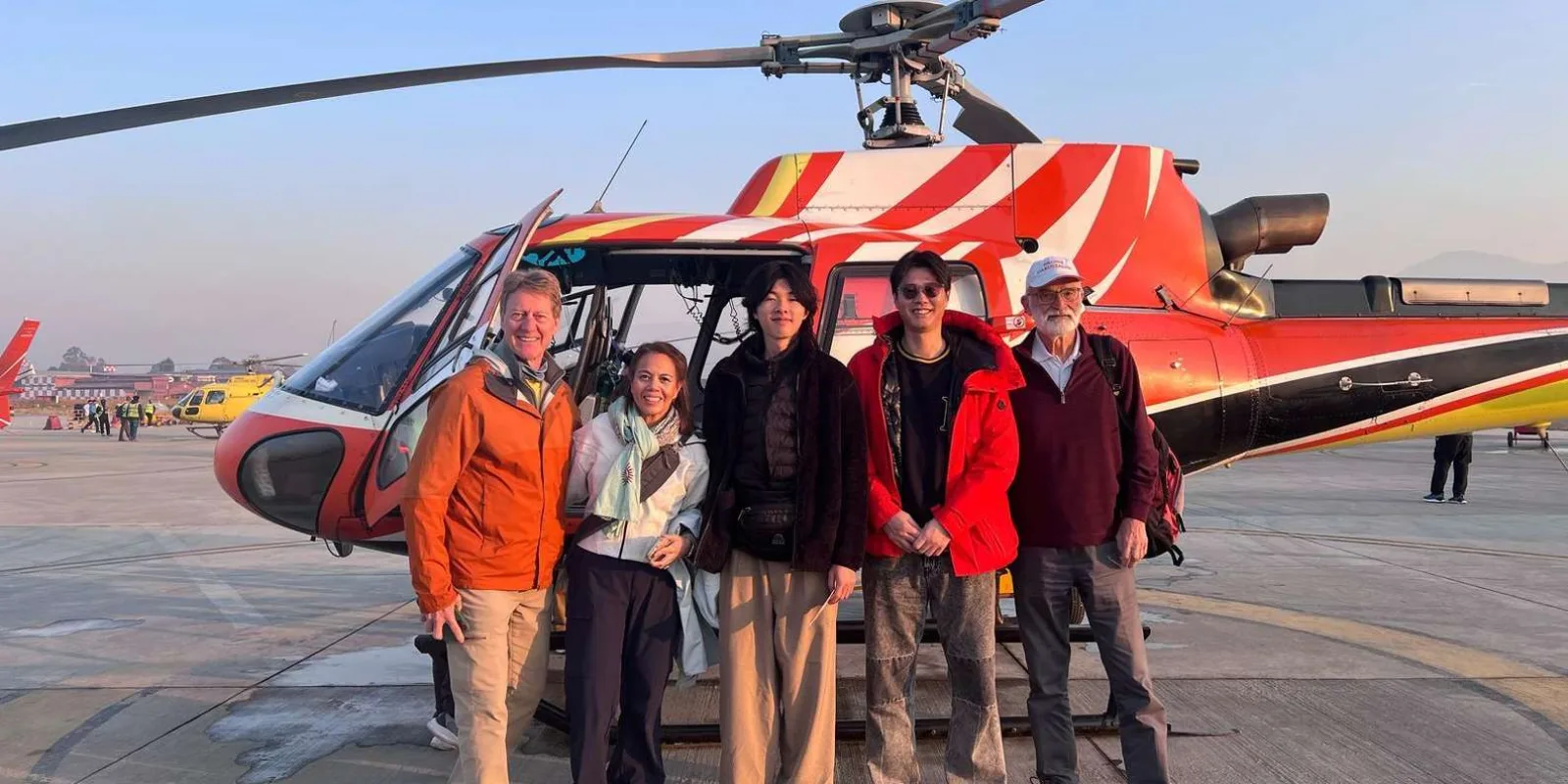
"Everything was perfect, from the pick-up at the hotel to the assistance before and after the flight. The pilot was very professional. A unique experience I highly recommend."
Kathmandu · Khumbu · Kalapatthar
Everest Helicopter Tour from Kathmandu
Fly from Kathmandu into the Khumbu for Everest views, with stops depending on your option, weather and operating permissions. Confirm the landing plan and breakfast inclusions before booking.
From
$1,738
per person
Free cancellation
An Everest helicopter tour from Kathmandu is the fastest way to experience the Everest region without spending nearly two weeks trekking to Everest Base Camp.
Most trips leave Kathmandu early in the morning and fly east toward the Himalayas, passing over mountain valleys and Sherpa settlements before reaching the Khumbu region. Depending on the tour and conditions, the itinerary may include Lukla, Everest Base Camp, Kala Patthar, Hotel Everest View and panoramic views of Everest, Lhotse, Nuptse and Ama Dablam.
The entire experience typically takes only a few hours.
That makes an Everest helicopter flight particularly attractive if you want to see Mount Everest but have limited time in Nepal.
But there is an important catch:
“Everest Base Camp helicopter tour” does not always mean the helicopter lands at Everest Base Camp.
Routes, landing locations, passenger limits and high-altitude procedures can vary considerably between products.
This guide explains what to expect before booking.
Price note, 24 September 2026: All dollar figures here are illustrative USD planning budgets, not live quotes or guaranteed fares. Confirm the date, group size, per-person versus whole-aircraft basis, taxes and meal inclusions before payment.
Compare the Kathmandu Everest-region helicopter itinerary. Its listing mentions both a landing and a flyover at Kala Patthar: confirm the actual route for your date. Hotel Everest View can be replaced by another breakfast stop in unsuitable weather; check meal charges separately.
Book Your Experience
Check Availability & Prices
Select your preferred date and time. Instant confirmation — free cancellation up to 24 hours before departure.
- 4.9 / 5 30+ Reviews
- 4.5 hours Duration
- 5,545m Kalapatthar Landing
- Licensed Pilot Aviation Insured
- Free Cancellation
The Experience
What Makes This Tour Special
Everything that makes this a top-rated experience.
Highlights
- Everest-region views with a Kala Patthar landing or flyover depending on the confirmed option, weather and operating permissions
- 45-minute flight from Kathmandu over the foothills to Lukla, the gateway to the Everest region, with a short refuelling stop at Tenzing–Hillary Airport
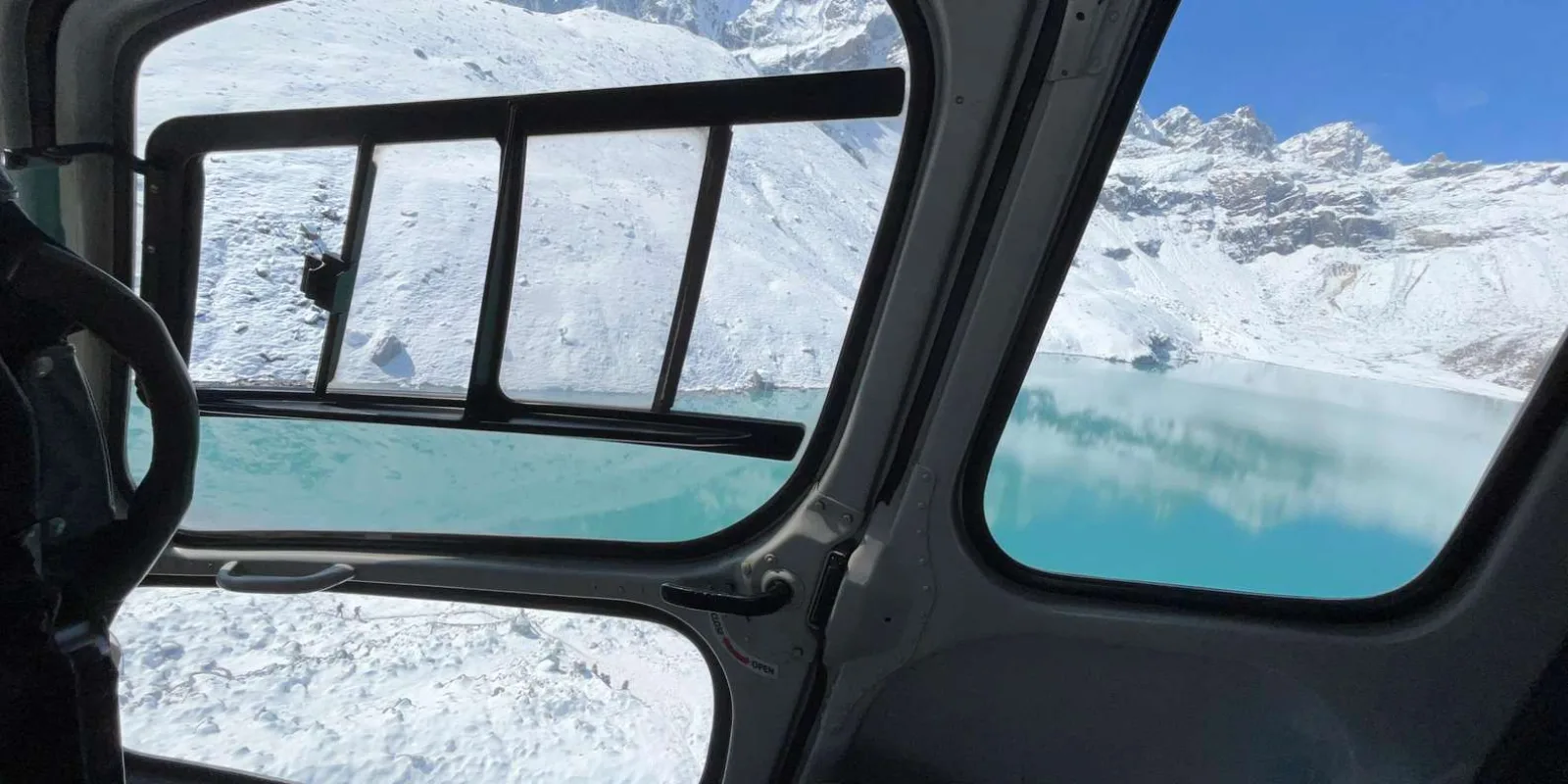
- A 25-minute stretch over Namche Bazaar, Tengboche Monastery, Pheriche and the Khumbu Glacier before the Kalapatthar landing
- Breakfast at the Hotel Everest View (3,880m), one of the highest-altitude hotels on Earth, with Everest framed in the dining-room window
- Window visibility and seating depend on aircraft layout and weight-and-balance requirements
- Round-trip from Kathmandu in half a day, with no acclimatisation days and no multi-week trekking itinerary
What's Included
- Hotel pickup and drop-off in Kathmandu
- One chartered helicopter flight, shared with other travelers to keep the per-seat price down
- Upper Khumbu sightseeing; confirm the landing plan for your departure
- Refuelling stop at Lukla Airport
- Oxygen on board for emergencies, plus standard aviation insurance
How It Works
Four simple steps to your booking.
Early Hotel Pickup in Kathmandu
Your driver collects you from anywhere in the Kathmandu Valley before sunrise and transfers you to the domestic terminal of Tribhuvan International Airport for a safety briefing.
Fly North to the Khumbu
The helicopter climbs over the foothills to Lukla for a short refuelling stop, then continues past Namche Bazaar, Tengboche Monastery and the Khumbu Glacier.
Explore the Upper Khumbu
The upper Khumbu offers views of Everest, Nuptse and the glacier. Confirm whether your selected option includes a landing or flyover; weather and operating permissions determine what is possible.
Breakfast at Everest View Hotel
Some routes stop near Hotel Everest View at 3,880m before returning to Kathmandu. A different stop may be used in unsuitable weather; confirm whether breakfast is included or payable separately.
Photo Gallery
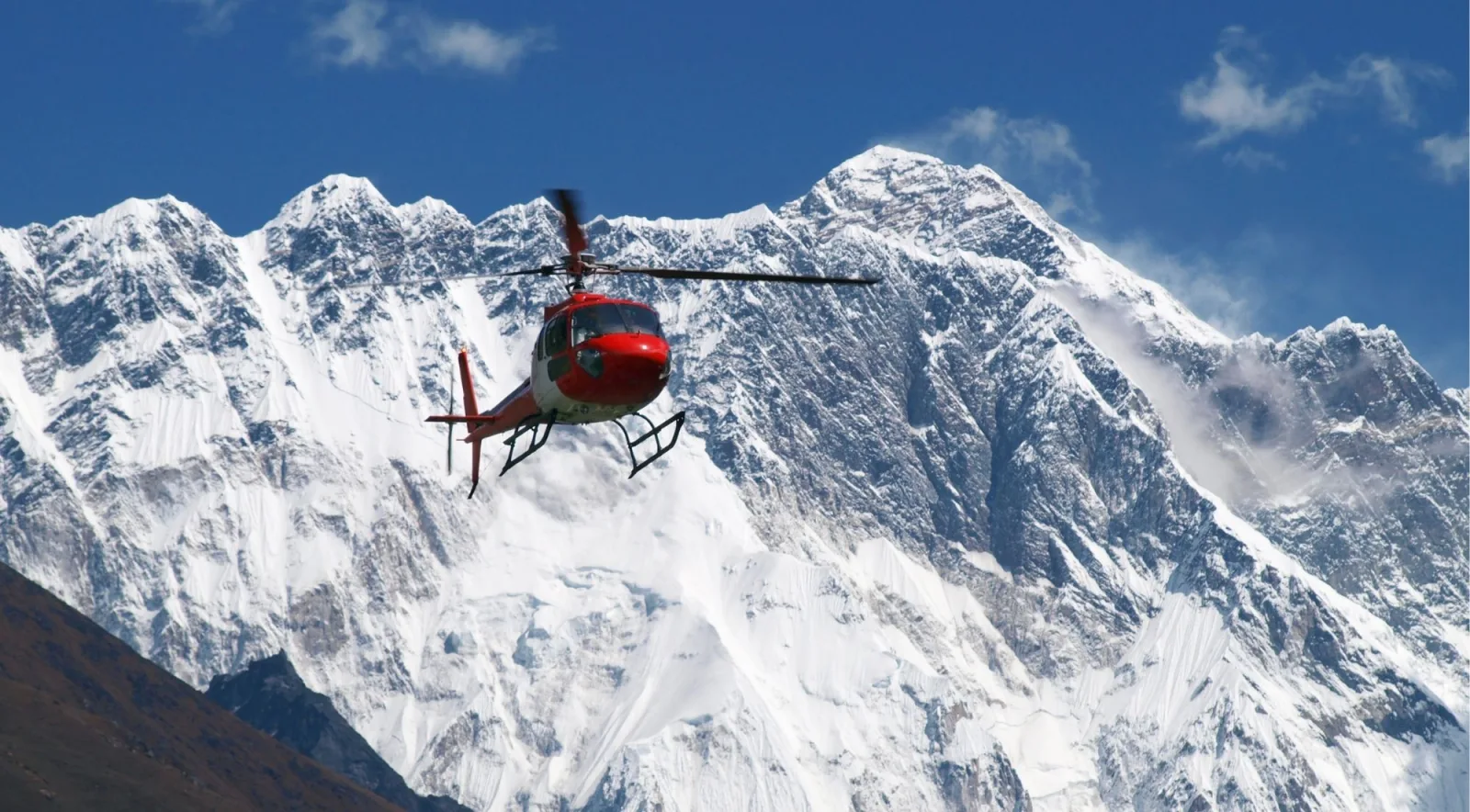
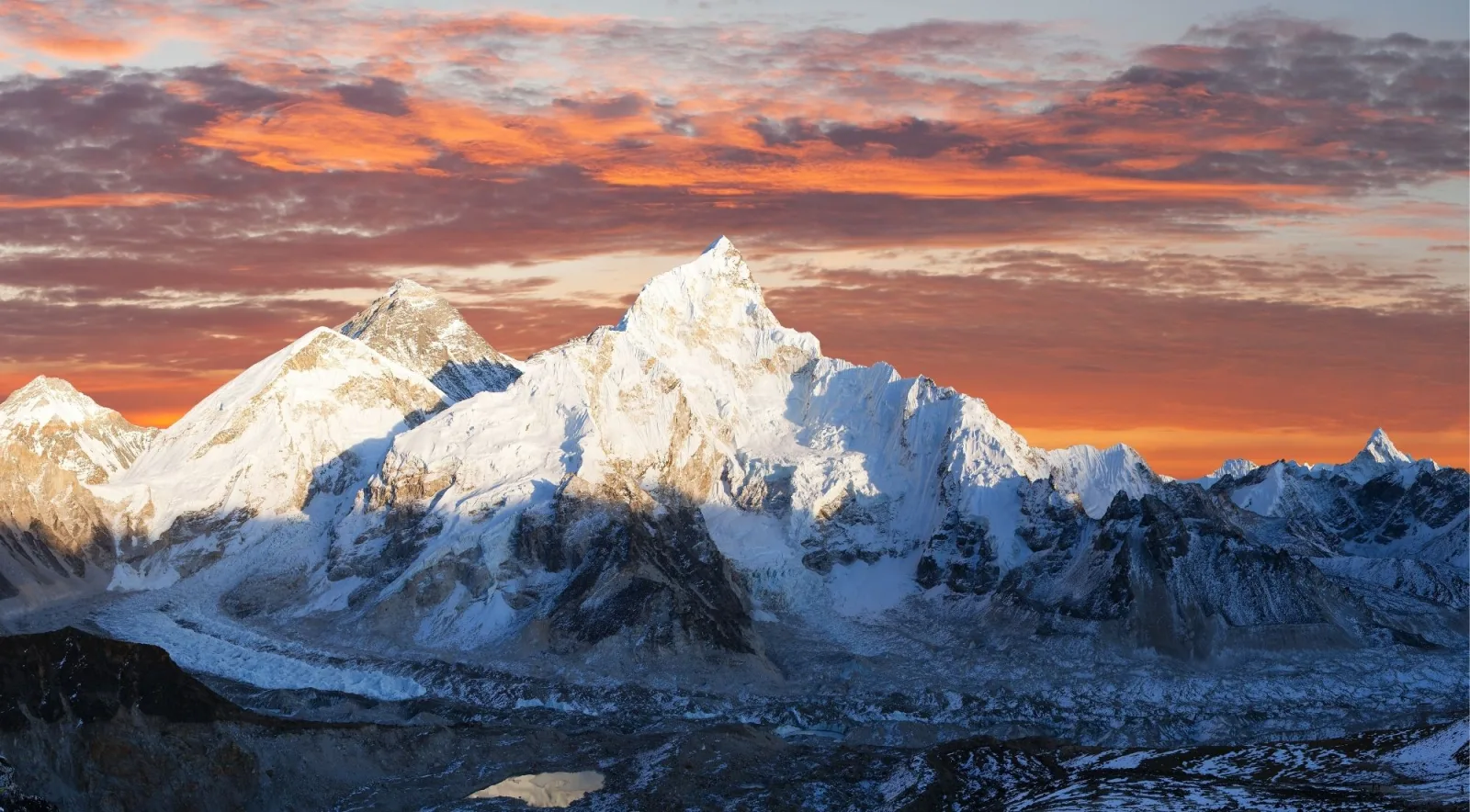
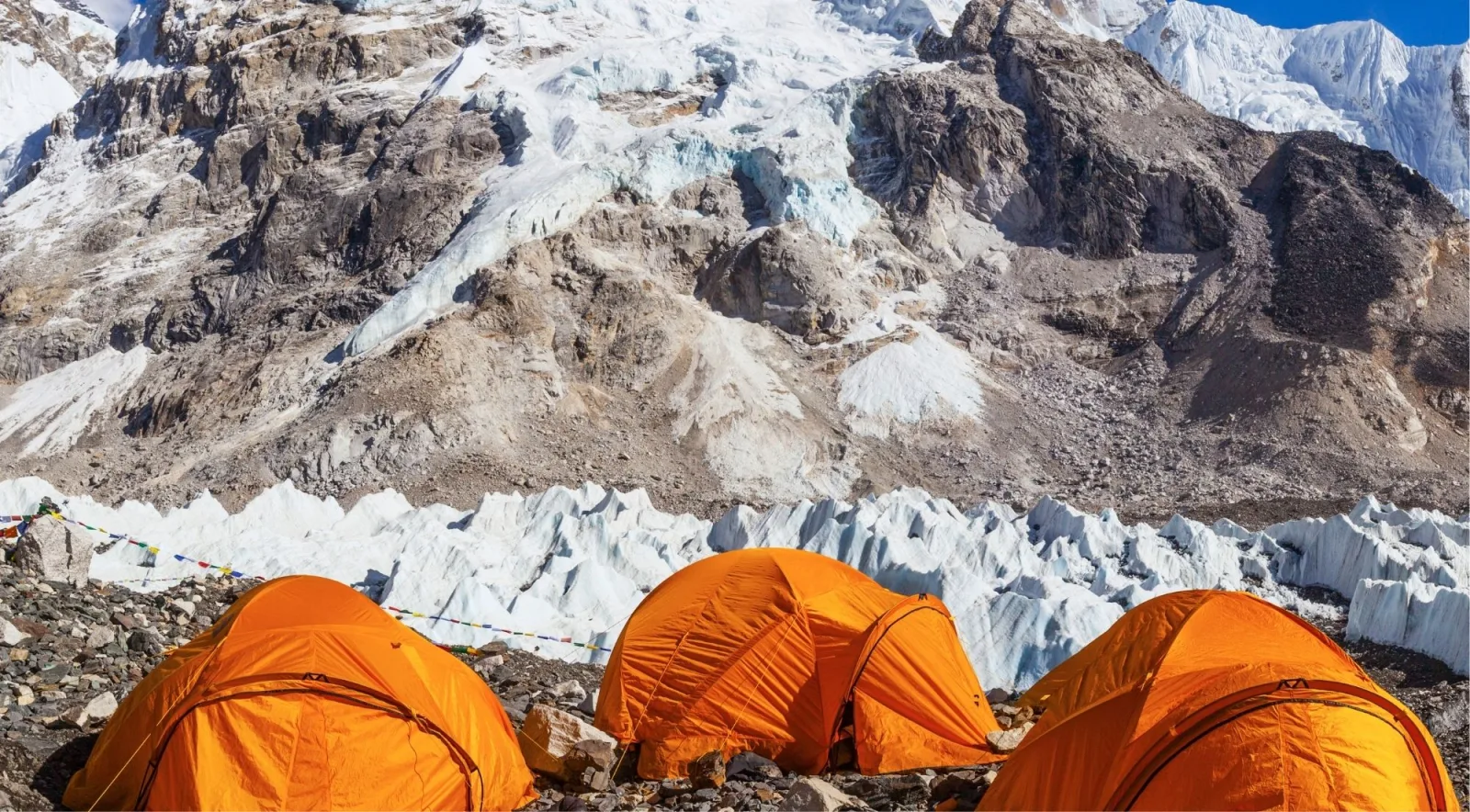
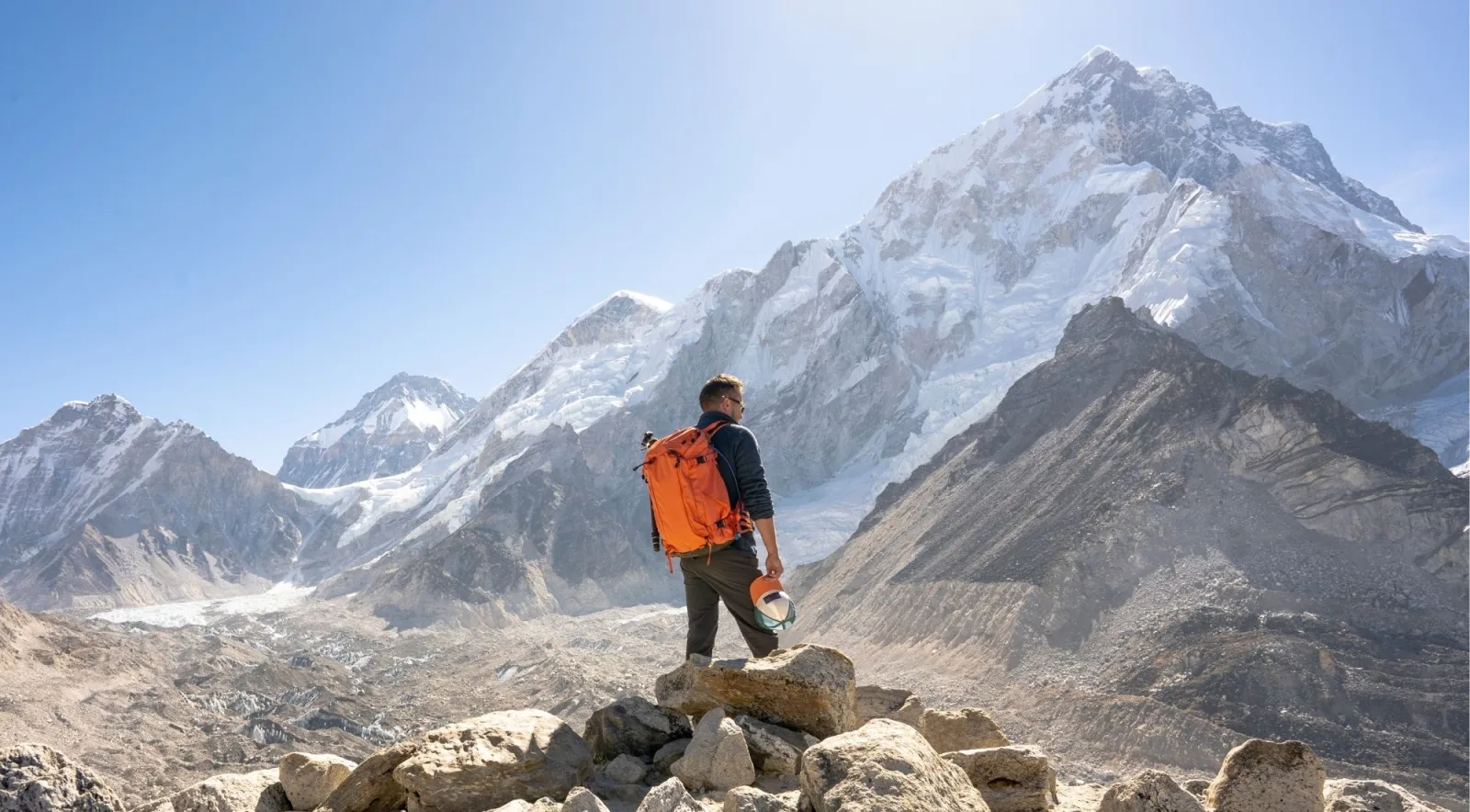
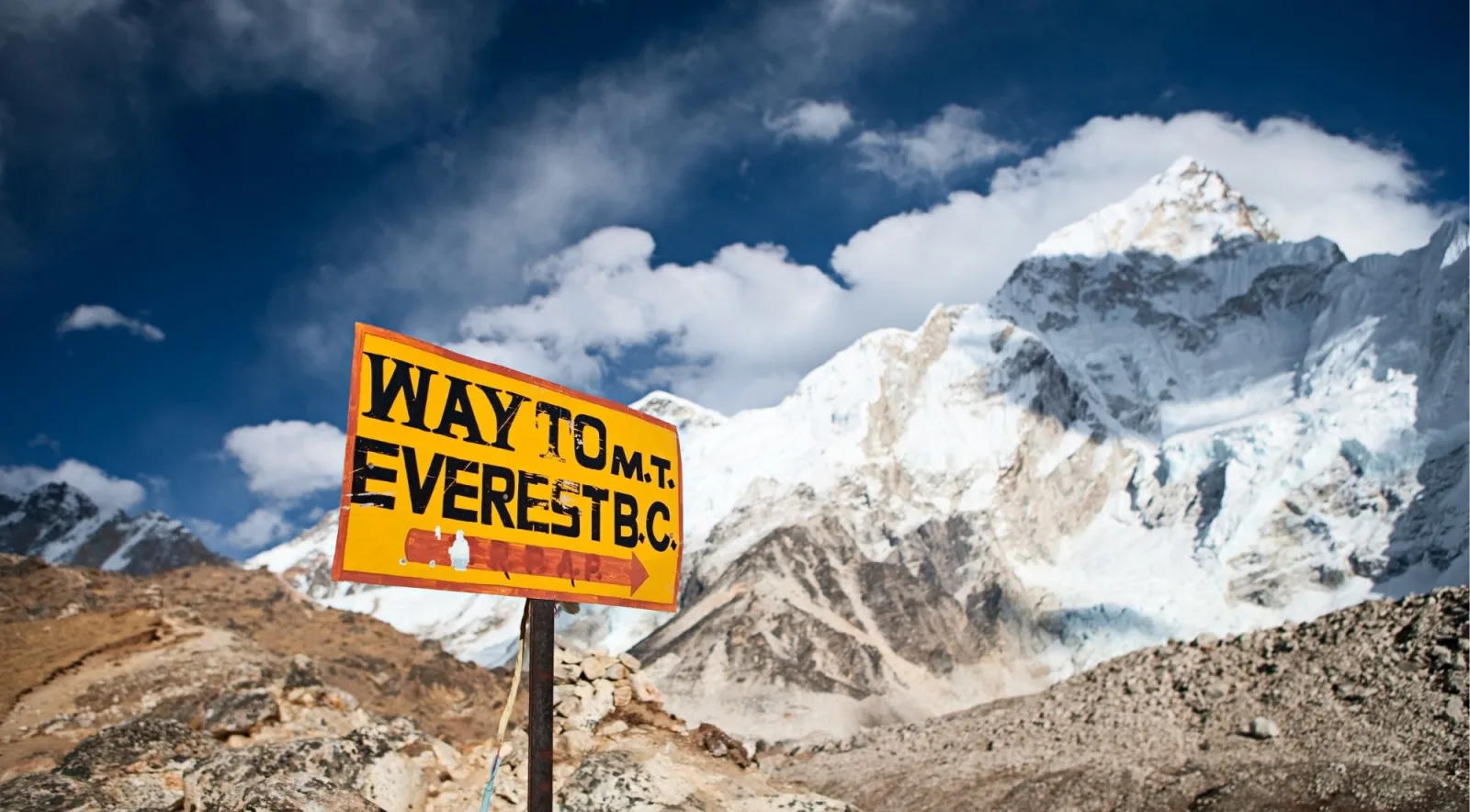
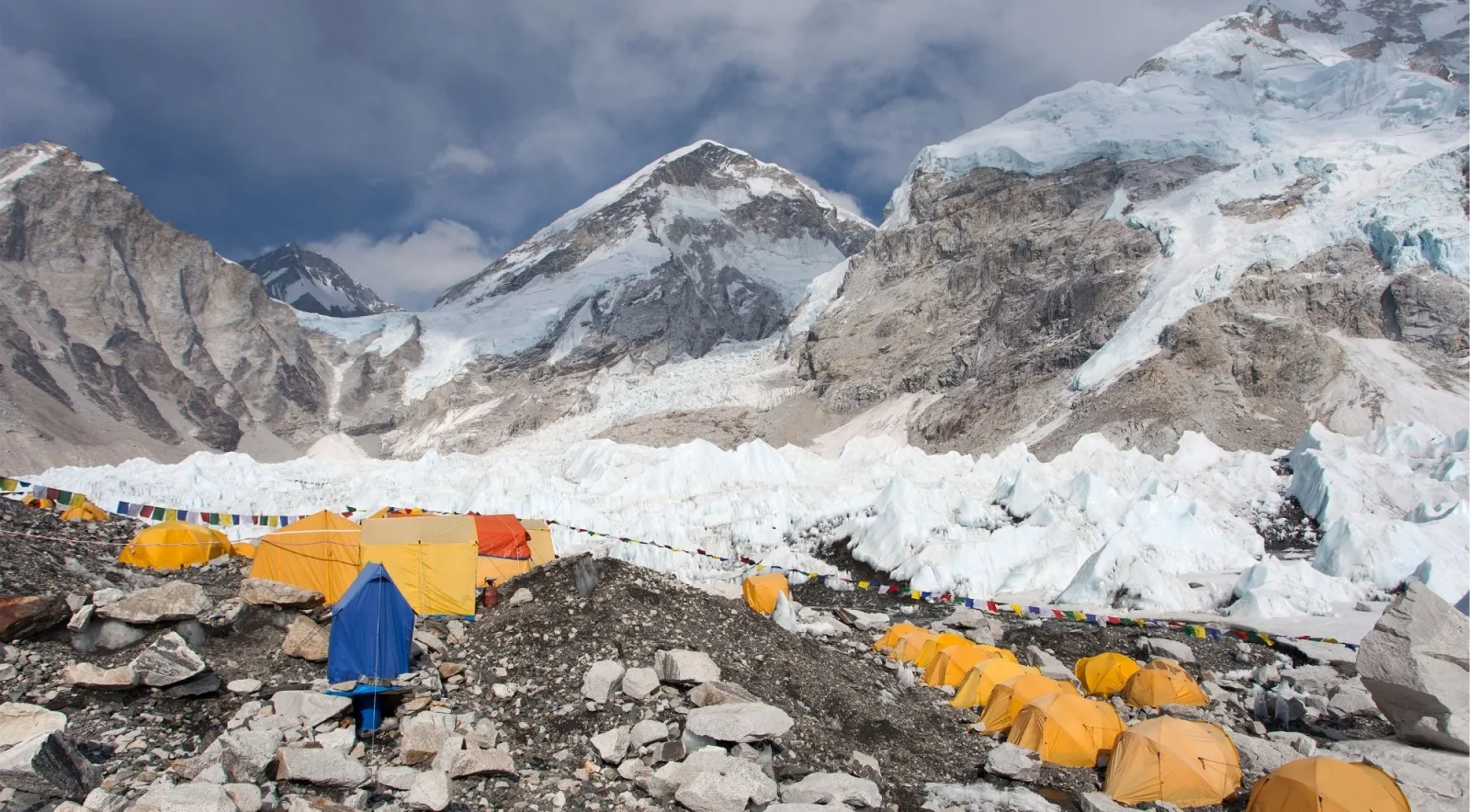
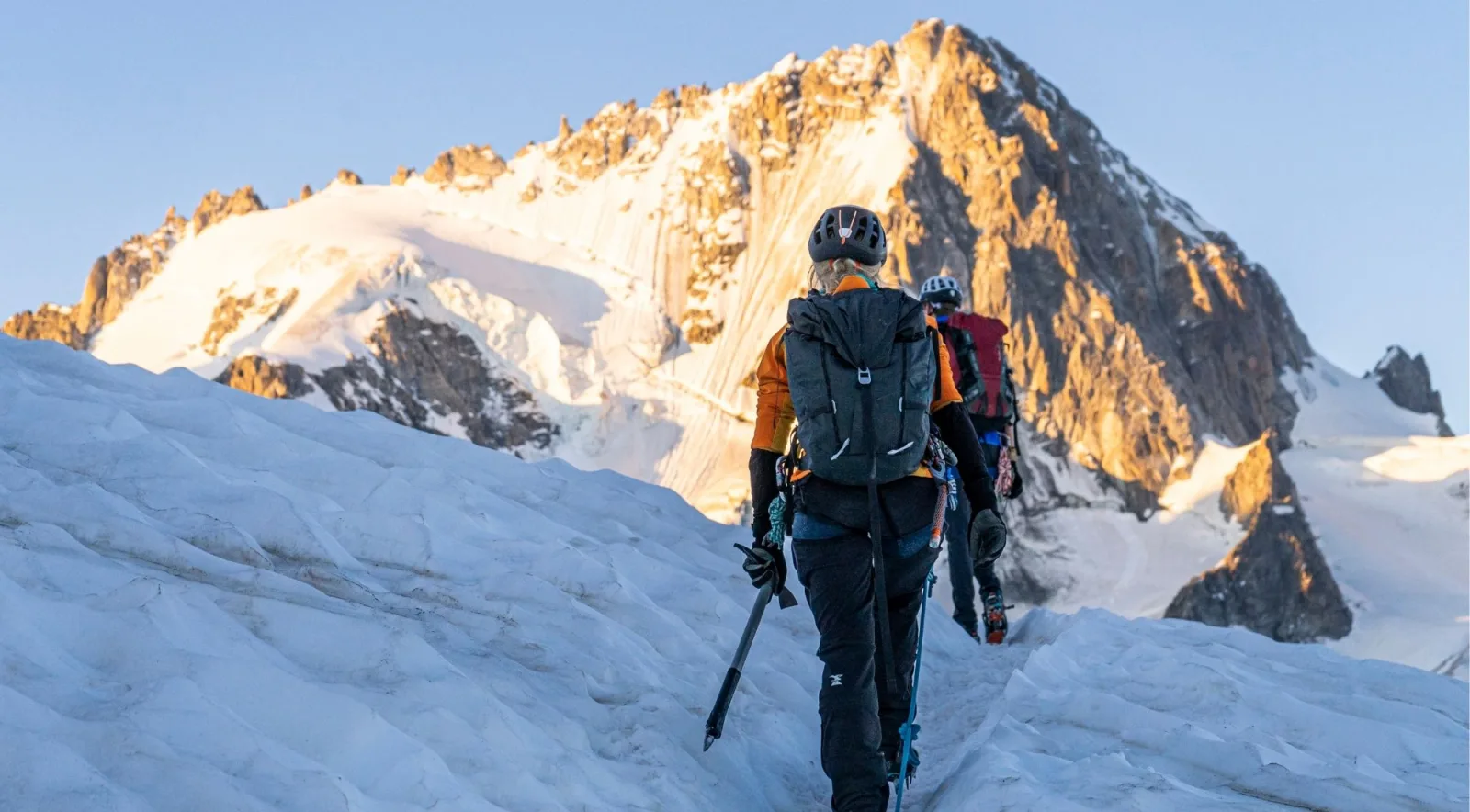
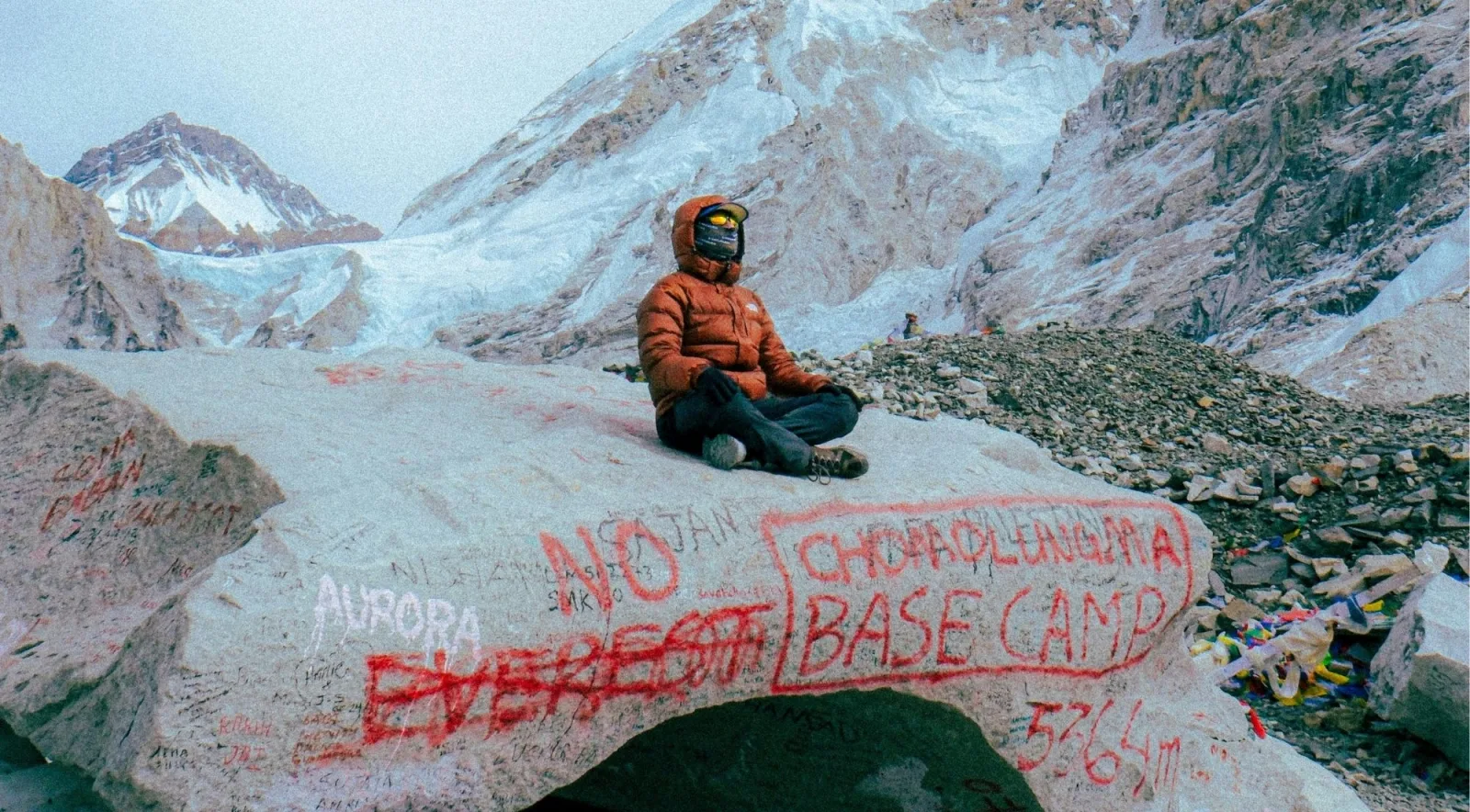
Everest From the Air
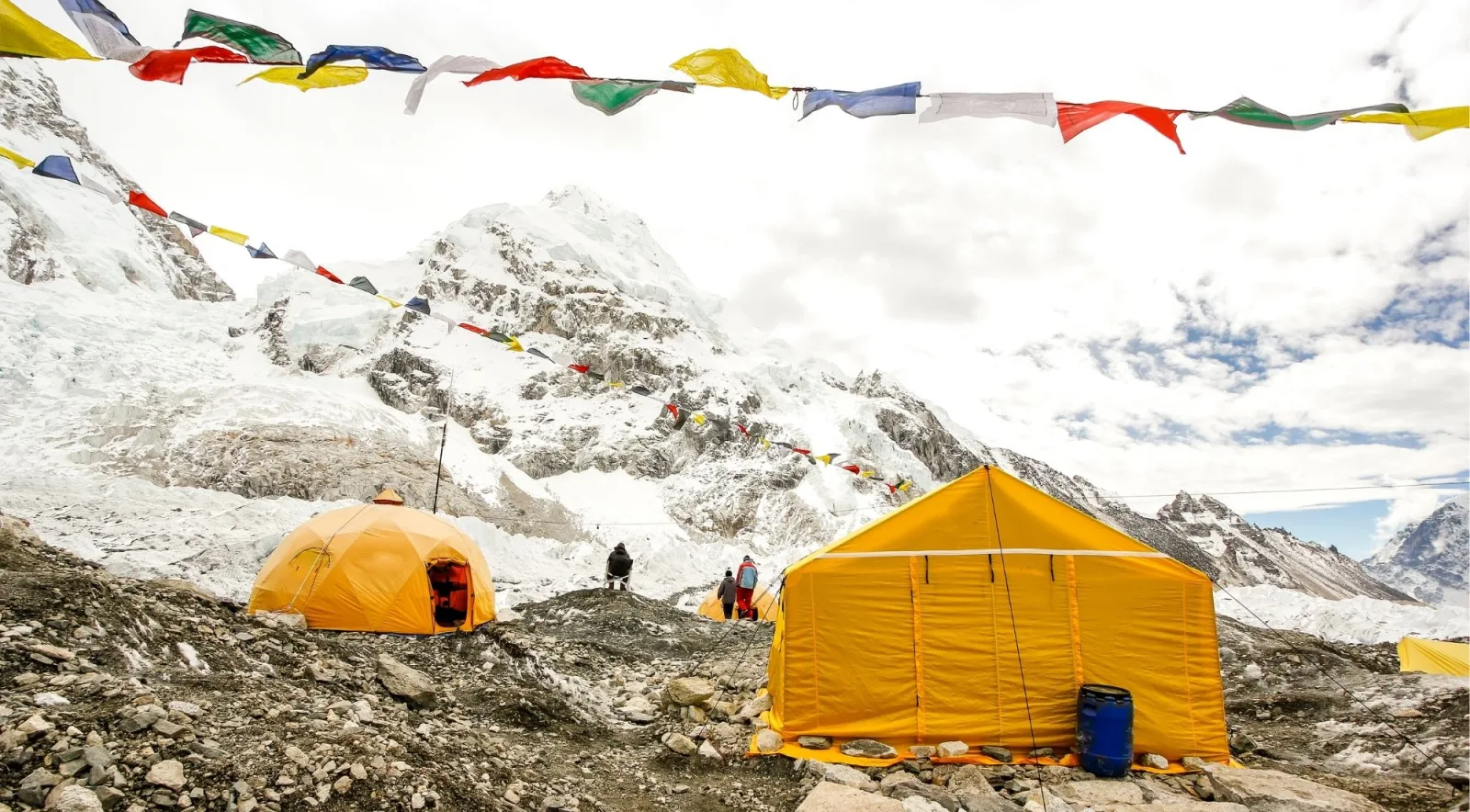
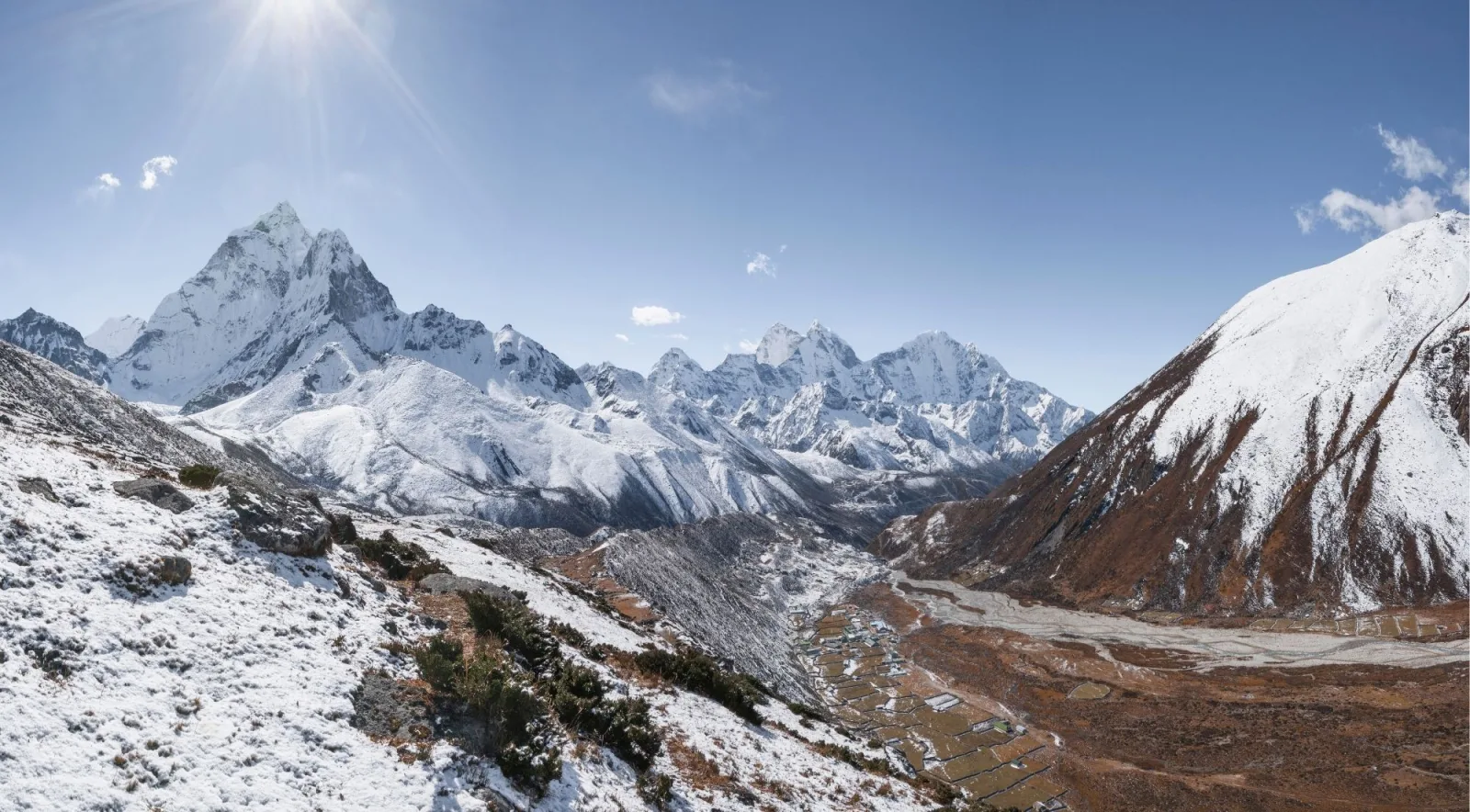
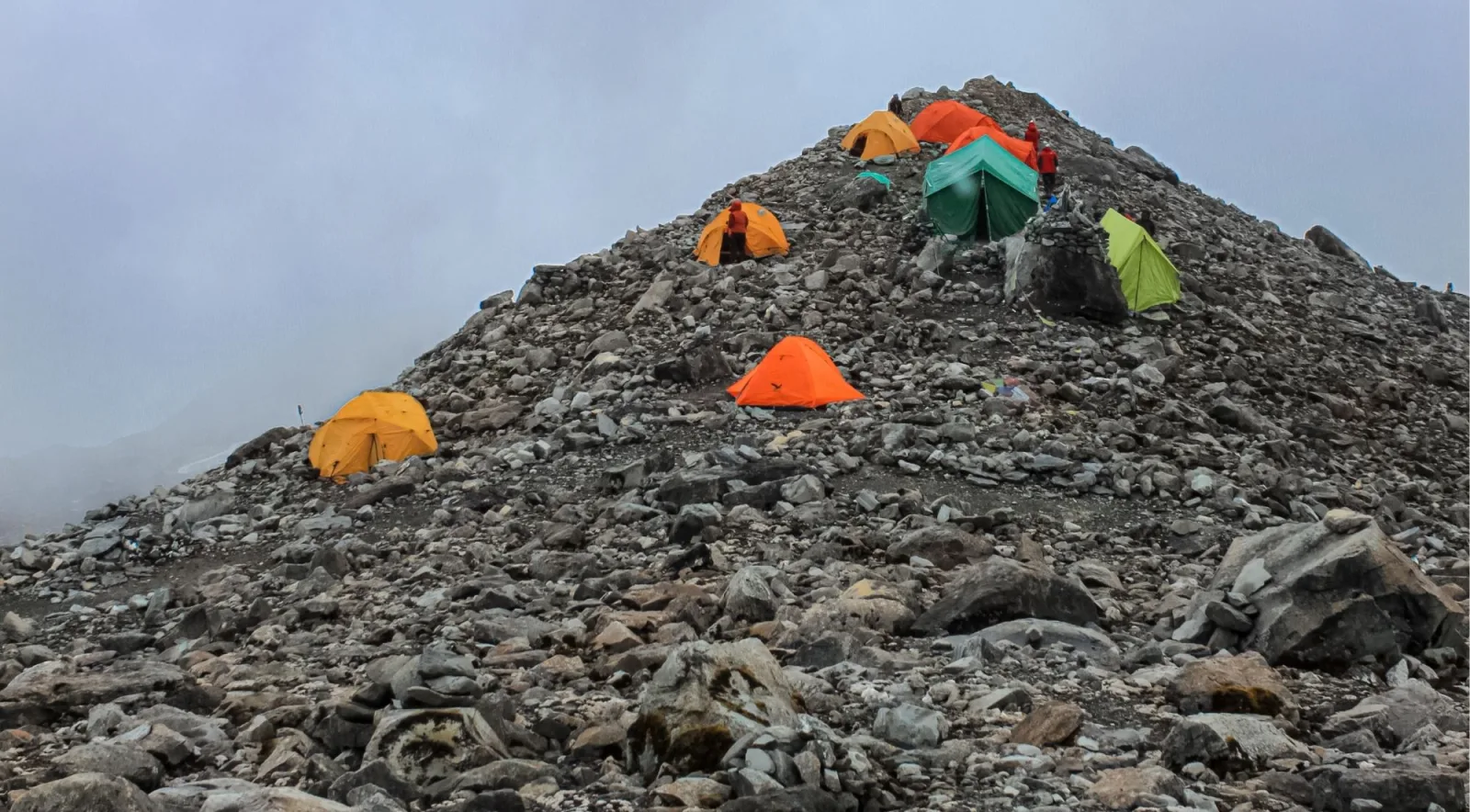
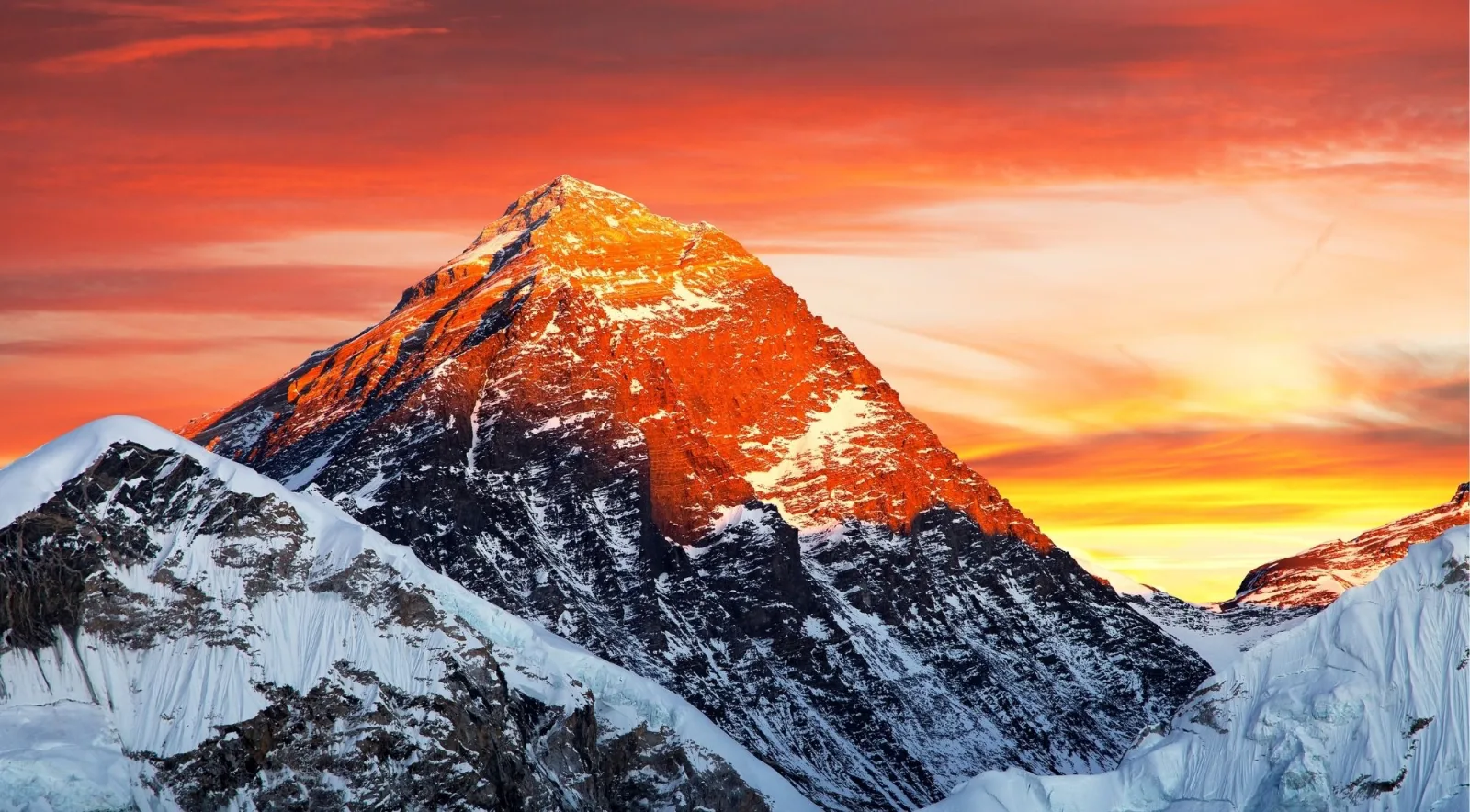
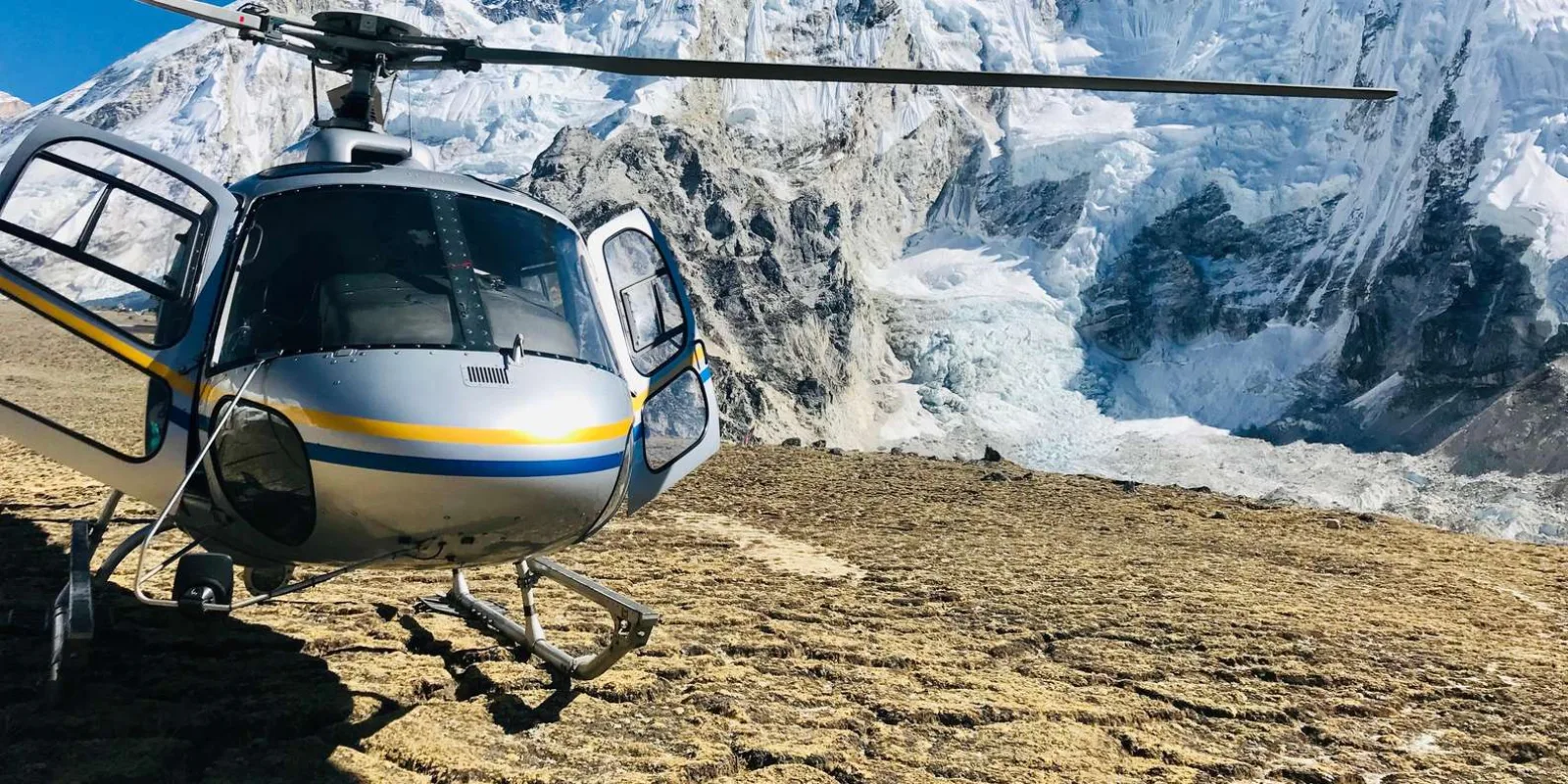
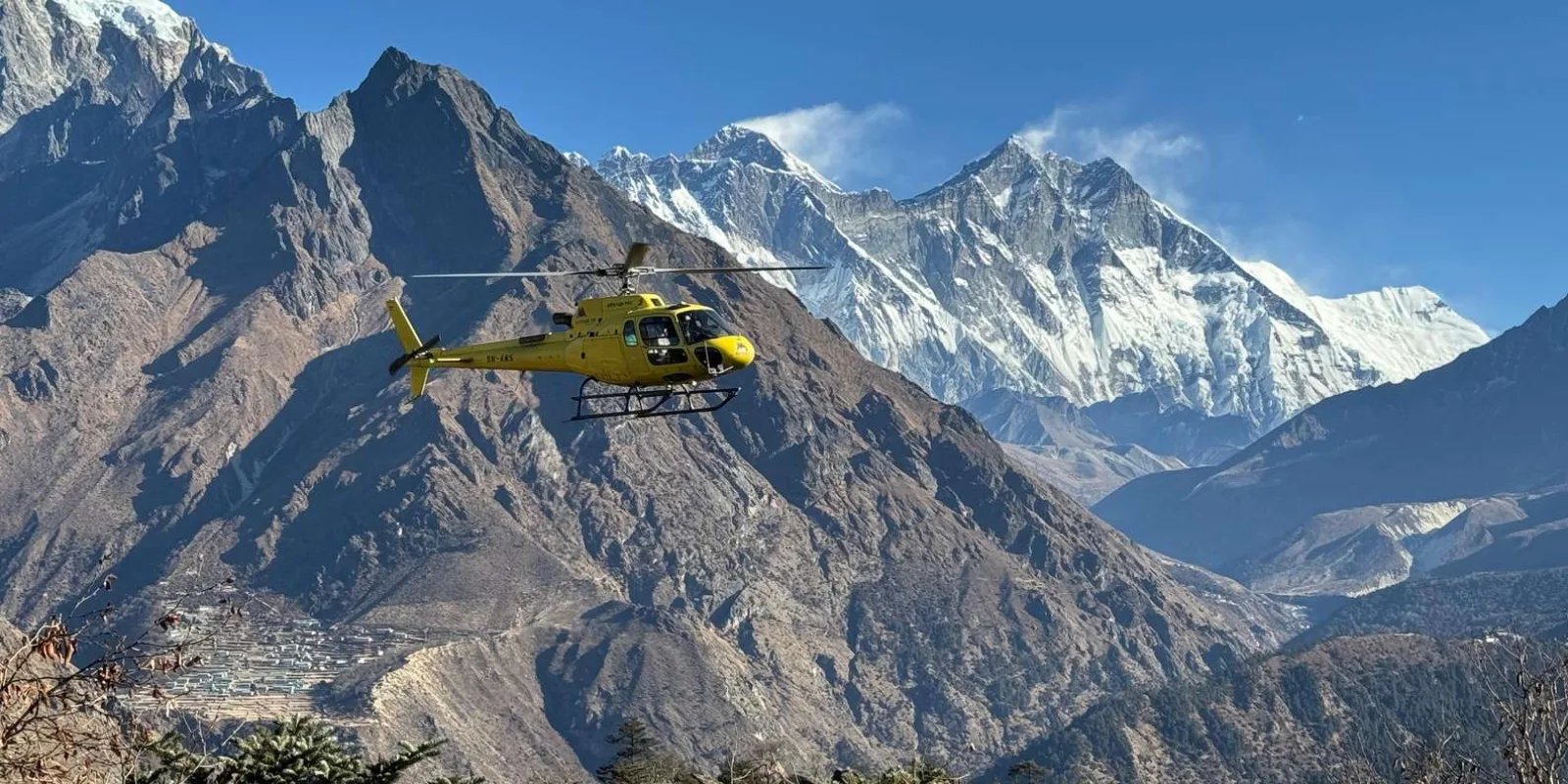
The Himalayas as only a helicopter passenger sees them — Kalapatthar, the Khumbu Glacier, and the Everest View Hotel.
Helicopter Tour vs Trekking vs Scenic Flight
Three real ways to see Everest from Kathmandu — here's how they actually compare.
| Feature | RECOMMENDED EBC Helicopter Tour | 12-Day EBC Trek | Scenic Flight by Plane |
|---|---|---|---|
| Time Required | 4–8 hours, round-trip same day | 10–14 days including acclimatisation | 1 hour, same-morning return |
| Physical Difficulty | Minimal walking; rapid high-altitude exposure still matters | Strenuous — multi-day high-altitude hiking | None — seated the entire flight |
| Lands Near Everest | Stops depend on option, weather and operating permissions | ✓ Walks to Base Camp and Kalapatthar on foot | Circles at a distance — no landing |
| Altitude Reached | Depends on confirmed route; Hotel Everest View is 3,880m | 5,364m (Base Camp), 5,545m (Kalapatthar) | Cabin altitude only — no ground exposure |
| What's Included | Flight and transfers; confirm landings, breakfast and fees separately | Guide, porter, teahouse lodging, permits (multi-day package) | 1-hour flight, window seat, hotel transfer |
| Weather Risk | Rescheduling/refund terms vary; used transfers may be deducted | Spread across 10+ days — far more buffer to wait out bad weather | Flight-dependent — free reschedule or refund if grounded |
| Free Cancellation | ✓ Up to 24 hours before | Varies by trekking operator | ✓ Up to 24 hours before |
| Starting Price | From $1,738/per person | From $1,200–2,500+ depending on operator and group size | From $100–200/person |
| Book Now | Browse Options |
Choose Your Flight
Everest Base Camp Helicopter Tours from Kathmandu
Five real, bookable helicopter tours — from a budget shared flight to a premium landing with a quieter breakfast stop.
 BUDGET PICK
Everest Base Camp Helicopter Tour — Budget Shared Flight
 GREAT VALUE
Everest Base Camp Helicopter Tour with Breakfast at Everest View Hotel
 GOKYO RI ADD-ON
Everest Base Camp & Gokyo Ri Helicopter Tour
 MOST BOOKED
Everest Base Camp Helicopter Tour with Kalapatthar Landing
 PREMIUM
Everest Base Camp Helicopter Tour with Landing — Premium
The Complete Guide
Everest helicopter tour: the complete guide
Routes, costs, landings, weather and practical booking questions.
Everest helicopter tour at a glance
| Everest Helicopter Tour | |
|---|---|
| Starting point | Kathmandu |
| Typical duration | Around 4–5 hours |
| Main region | Khumbu / Everest |
| Everest visible? | Yes, weather permitting |
| Everest Base Camp | Usually viewed from the air or included in the route |
| High-altitude stop | Depends on tour and operating conditions |
| Hotel Everest View | Included on many itineraries |
| Typical shared price | Around $1,200–$1,700+ per person |
| Private charter | Several thousand dollars per helicopter |
| Best general seasons | Spring and autumn |
| Trekking required | No |
| Return to Kathmandu | Same day |
Published itineraries from established Nepal helicopter operators show Everest sightseeing trips of roughly four to five hours, although the exact itinerary varies by product. (airdynastyheli.com)
What is an Everest helicopter tour?
An Everest helicopter tour is a sightseeing flight from Kathmandu into Nepal’s Everest region.
Instead of walking from Lukla toward Everest Base Camp over many days, you cover much of the same geography from the air.
A typical flight progresses roughly like this:
Kathmandu → Lukla → Khumbu Valley → Everest region → high-altitude viewpoint/stop → Hotel Everest View area → Kathmandu
The exact route should never be assumed.
Weather, visibility, aircraft weight, aviation rules and conditions in the mountains can all affect what happens on the day.
The essential experience, however, is remarkably consistent:
You leave the Kathmandu Valley and within a relatively short time find yourself flying among some of the highest mountains on Earth.
Can't Make These Dates?
Browse More Available Options
Find a tour that fits your schedule — all with instant confirmation and free cancellation.
Can you really see Mount Everest from a helicopter?
Yes.
On a clear day, an Everest helicopter flight offers views of Mount Everest and many of the great peaks surrounding it.
Depending on the route and visibility, you may see mountains including:
- Mount Everest
- Lhotse
- Nuptse
- Ama Dablam
- Thamserku
- Pumori
- Cho Oyu and other Himalayan peaks from appropriate viewpoints
The scenery changes dramatically throughout the flight.
Kathmandu gives way to green hills and river valleys. The terrain becomes progressively more mountainous as you approach Lukla, then much more severe as you enter the high Khumbu.
By the time you reach the Everest region, enormous glaciers and snow-covered peaks dominate the landscape.
How long is the Everest helicopter tour from Kathmandu?
Most full Everest helicopter sightseeing excursions take approximately four to five hours overall, although the exact duration can vary.
A current Everest helicopter itinerary from Air Dynasty, for example, is advertised at about four hours for its Kala Patthar-focused product and five hours for its broader Everest Base Camp helicopter tour. (airdynastyheli.com)
Do not expect four or five continuous hours in the air.
The trip normally includes some combination of:
- Kathmandu airport procedures
- fuel stops
- passenger or weight adjustments
- high-altitude stops
- sightseeing
- breakfast or refreshments
- return flight
Weather can also create delays.
For that reason, it is sensible not to schedule an international flight or another inflexible activity immediately afterward.
What does a typical Everest helicopter itinerary look like?
Every operator structures the trip slightly differently, but this is a useful example of how the morning can unfold.
1. Early hotel pickup in Kathmandu
Everest helicopter flights generally leave early.
Morning conditions are often preferable for mountain visibility and flying, so hotel pickups can begin shortly after sunrise.
You travel to Kathmandu’s airport and complete check-in and the pre-flight briefing.
2. Kathmandu to Lukla
The first major stage is the flight from Kathmandu toward Lukla.
This part alone is spectacular.
You leave the Kathmandu Valley and fly across Nepal’s middle hills toward the Himalayas.
As the flight progresses, the terrain becomes increasingly dramatic.
Lukla sits at approximately 2,860 metres and is the traditional gateway for Everest Base Camp trekkers.
Many helicopter itineraries use Lukla as an operational or fuel stop.
3. Lukla into the Khumbu
Beyond Lukla, you enter the Everest region itself.
This is where the scenery becomes much more alpine.
Depending on the flight path, you may see places associated with the classic Everest trail, including the Namche Bazaar area, Tengboche, Pheriche and the upper Khumbu.
The Nepal Tourism Board describes Tengboche as offering panoramic views toward Everest, Lhotse and Ama Dablam, with Kala Patthar farther up the valley at about 5,545 metres. (ntb.gov.np)
4. Everest Base Camp and the Khumbu Glacier
The helicopter continues toward the highest part of the route.
From the air you may see:
- Everest Base Camp
- Khumbu Glacier
- Khumbu Icefall
- Gorak Shep
- Kala Patthar
- surrounding Himalayan peaks
This is usually the visual climax of the trip.
Everest Base Camp itself lies at approximately 5,364 metres, while nearby Kala Patthar rises to about 5,545 metres.
Read our guide to Everest Base Camp altitude for a comparison of the major elevations.
5. High-altitude stop
This part varies most between tours.
Some products advertise a Kala Patthar or high-altitude landing, while others use different stopping arrangements.
Current tour listings can still advertise Kala Patthar landings, but high-altitude helicopter operations depend on operational approvals, conditions and restrictions on the day. (airdynastyheli.com)
For that reason, don’t book purely because a product title says “Kala Patthar landing.”
Check the latest itinerary and terms.
6. Hotel Everest View
Many Everest helicopter itineraries include a stop around Hotel Everest View, above Namche Bazaar.
The attraction is obvious.
You are still surrounded by Himalayan scenery, but you are at a significantly lower altitude than Kala Patthar or Everest Base Camp.
Some tours advertise breakfast here.
Check whether breakfast is actually included in the ticket or simply available to purchase.
7. Return to Kathmandu
After the final stop, the helicopter returns toward Kathmandu.
You normally arrive back in the capital before or around midday if everything runs to schedule.
In one morning, you have travelled from Kathmandu into the Everest region and back.
Does the helicopter land at Everest Base Camp?
This is one of the most misunderstood parts of Everest helicopter tours.
Do not assume that an Everest Base Camp helicopter tour means you will step out of the helicopter at Everest Base Camp itself.
“Everest Base Camp helicopter tour” is commonly used as the name for the overall sightseeing experience.
An itinerary may:
- fly over Everest Base Camp
- fly close to EBC
- include another high-altitude landing
- stop around Kala Patthar
- stop at Hotel Everest View
- use Pheriche or another location operationally
What is possible can also change.
Everest is a tightly managed high-altitude aviation environment, and Nepal’s aviation authority regulates helicopter operations in the region. (flightsafety.caanepal.gov.np)
Always read the itinerary that applies to your specific departure, not a generic description from an old blog post.
What is the difference between Everest Base Camp and Kala Patthar?
Everest Base Camp is the famous destination.
Kala Patthar is the famous viewpoint.
They are close together, but they serve very different purposes.
Everest Base Camp
Altitude: approximately 5,364 m
Best known for:
- Everest climbing expeditions
- Khumbu Glacier
- Khumbu Icefall
- the symbolic experience of reaching EBC
Kala Patthar
Altitude: approximately 5,545 m
Best known for:
- panoramic Everest views
- photography
- being higher than Base Camp
The Nepal Tourism Board specifically describes Kala Patthar as being known for outstanding views of Mount Everest. (ntb.gov.np)
This is why a helicopter itinerary mentioning Kala Patthar can sound more attractive to sightseeing visitors than one focused exclusively on Base Camp.
Can you see Everest from Everest Base Camp?
Not nearly as well as many first-time visitors expect.
Everest Base Camp lies beneath the mountain, but surrounding terrain partially obstructs the recognisable summit view.
This sounds counterintuitive:
You can travel all the way to Everest Base Camp and still not get the classic Everest panorama.
Kala Patthar is generally the more celebrated viewpoint.
From a helicopter, however, your perspective is different again because you see the landscape from above and move through several viewing angles during the flight.
How much does an Everest helicopter tour cost?
A shared Everest helicopter tour is one of Nepal’s most expensive sightseeing activities.
For 2026, a reasonable planning range is approximately:
$1,200–$1,700+ per person for a shared flight
Private charters generally cost several thousand dollars for the helicopter.
Air Dynasty publishes shared-seat and private Everest helicopter itineraries. Compare its live quote with the marketplace options for the same landing plan and inclusions; older $1,399 or $1,700 examples should not be treated as current fares. (airdynastyheli.com)
Read our full guide to Everest helicopter tour prices before booking.
Shared vs private Everest helicopter tour
You normally have two choices.
Shared helicopter tour
You buy a seat and fly with other passengers.
This is the sensible option for most:
- solo travellers
- couples
- two or three friends
- visitors trying to keep costs reasonable
Private helicopter
You charter the aircraft for your group.
It gives you greater privacy but costs considerably more.
A private charter can become more financially interesting if you are travelling with several people, although high-altitude passenger and payload limits still apply.
Do not simply divide a helicopter’s theoretical passenger capacity by its charter price.
High-altitude operations can require passenger redistribution or additional shuttle movements.
How many passengers fit in an Everest helicopter?
Helicopters used for mountain flying commonly carry several passengers, but the number of people that can be carried safely depends on factors including:
- aircraft type
- passenger weight
- fuel
- temperature
- altitude
- landing location
An aircraft capable of carrying five passengers at lower altitude may not necessarily carry the same payload to the highest landing point.
This is one reason some itineraries involve passenger splitting or shuttles.
If your group wants to remain together, ask the operator specifically how the high-altitude portion of the flight works.
Why does altitude affect helicopter capacity?
Helicopters lose performance as air density decreases.
At high altitude, the air is thinner.
That affects both aerodynamic performance and the power margins available to the aircraft.
The Everest region takes this to an extreme.
Everest Base Camp is above 5,300 metres and Kala Patthar is above 5,500 metres.
Passenger weight therefore matters much more here than it would on a helicopter sightseeing trip close to sea level.
This is not simply an airline being awkward about baggage.
Weight and altitude are fundamental operational considerations.
Can you fly by helicopter to the summit of Mount Everest?
Not as an ordinary tourist sightseeing trip.
The summit of Everest sits at approximately 8,849 metres, in an extreme high-altitude environment.
Everest sightseeing tours operate much lower.
When you see phrases such as:
- “helicopter to Everest”
- “fly to Mount Everest”
- “Everest helicopter landing”
they mean flying into the Everest region, not stepping out of a helicopter on the summit.
No normal sightseeing product takes tourists for a summit landing.
How close does the helicopter get to Mount Everest?
Close enough for Everest to dominate the experience, but not in the sense of hovering beside the summit.
The flight travels into the Khumbu and provides views toward the Everest massif.
Your exact perspective depends on:
- route
- weather
- visibility
- landing location
- operating conditions
Remember that Everest is surrounded by other enormous mountains.
Lhotse, for example, is the world’s fourth-highest mountain and sits directly beside Everest.
Nuptse can also dominate the view from lower parts of the valley.
Knowing what you are looking at makes the flight considerably more interesting.
Is an Everest helicopter tour dangerous?
Any helicopter flight involves risk, and mountain aviation presents additional challenges.
The Everest region combines:
- high altitude
- rapidly changing mountain weather
- complex terrain
- reduced aircraft performance at altitude
- limited landing areas
For that reason, your priority should be booking with a properly authorised operator and respecting operational decisions made by pilots.
Nepal has a regulated rotor-wing aviation sector, and the Civil Aviation Authority of Nepal publishes information relating to helicopter operators and aviation oversight. (caanepal.gov.np)
A pilot cancelling or modifying a flight because of weather is not ruining your tour.
It is exactly the kind of decision you want the pilot to make.
What happens if the weather is bad?
Everest flights are weather-dependent.
Possible outcomes include:
- delayed departure
- modified route
- different landing point
- postponed flight
- complete cancellation
This makes the cancellation policy one of the most important things to check before paying.
Ideally, book your Everest flight near the beginning of your stay in Kathmandu.
For example:
Good plan:
Day 2 — Everest helicopter
Day 3 — Kathmandu sightseeing
Day 4 — free/flexible
Day 5 — leave Nepal
Riskier plan:
Final morning — Everest helicopter
Afternoon — international flight
The first itinerary gives you room to move the helicopter trip if conditions are unsuitable.
The second does not.
What is the best time for an Everest helicopter tour?
For most travellers, the strongest periods are:
March to May
Spring is one of the classic Everest seasons.
Advantages can include:
- relatively good mountain visibility
- active trekking season
- warmer temperatures than winter
- climbing activity around Everest in April and May
September to November
Autumn is another excellent period.
October and November are particularly popular for Himalayan travel because the monsoon has generally cleared much of the atmospheric haze.
A current Everest helicopter operator similarly identifies March–May and September–November as its preferred seasons for the trip. (airdynastyheli.com)
Can you take an Everest helicopter tour in winter?
Yes, helicopter flights can operate in winter when conditions allow.
December, January and February can offer exceptionally clear Himalayan views.
The obvious downside is cold.
At high altitude, temperatures can be severe, particularly early in the morning.
Winter also requires more flexibility because mountain weather still controls the flight.
For travellers interested mainly in sightseeing rather than trekking, however, winter should not automatically be dismissed.
What about the monsoon?
June through August is generally the more difficult period for reliable Himalayan sightseeing.
Cloud, rain and reduced visibility can interfere with flying.
That doesn’t mean every day is impossible.
It means your chances of disruption are greater and flexibility becomes much more important.
If Everest is one of the main reasons for your trip to Nepal, spring or autumn is generally a safer planning choice.
Is October good for an Everest helicopter tour?
Yes.
October is one of the strongest months for Everest sightseeing.
The monsoon has usually retreated, trekking season is in full swing and mountain visibility can be excellent.
The downside is demand.
Flights and accommodation in Nepal are busier, so booking ahead makes more sense than during quieter periods.
Is November good?
Very good.
November is often attractive because conditions can remain clear while crowds gradually reduce as the month progresses.
It becomes colder, especially at high altitude, but the helicopter means you are exposed to those conditions only briefly compared with trekkers.
For an October–November Nepal trip, I would consider an Everest helicopter flight a very strong fit.
What should you wear?
Even if Kathmandu feels warm, dress for the mountains.
Useful items include:
- warm insulated jacket
- fleece or warm mid-layer
- long trousers
- closed footwear
- warm socks
- hat
- gloves
- sunglasses
- sunscreen
Layering is ideal.
You can remove clothing in Kathmandu and put it back on before any high-altitude stop.
Do not judge what to wear based purely on the weather outside your Kathmandu hotel.
You could be more than four vertical kilometres higher a short time later.
Do you need hiking boots?
Not necessarily.
This is not a trek.
You normally won’t be walking significant distances.
Comfortable closed shoes with decent grip are generally more useful than heavy expedition boots for a sightseeing helicopter trip.
However, exact landing surfaces vary, so avoid unsuitable footwear such as loose sandals.
Do you need oxygen?
Most sightseeing passengers do not routinely use supplemental oxygen throughout the tour.
But altitude should still be taken seriously.
A rapid journey from Kathmandu at around 1,300 metres to elevations above 5,000 metres gives your body virtually no time to acclimatise.
High-altitude stops are therefore usually brief.
If you have a medical condition or specific concern about high altitude, ask an appropriate medical professional before booking.
Can children take an Everest helicopter tour?
Some operators accept children, but there is no universal rule covering every tour.
Before booking with children, check:
- minimum age
- seat pricing
- altitude policy
- whether the child can tolerate cold
- high-altitude stop duration
- operator requirements
The larger issue is not whether a child will enjoy a helicopter.
It is the rapid ascent to extreme altitude.
Discuss individual health concerns with an appropriate medical professional rather than relying on a tour description.
Is the Everest helicopter tour suitable for older travellers?
This is one of the groups for whom the experience can be particularly appealing.
A helicopter makes it possible to see the Everest region without:
- trekking for 12–14 days
- climbing thousands of metres on foot
- sleeping in remote mountain lodges
- carrying trekking equipment
That said, avoiding trekking does not remove the altitude issue.
Anyone with relevant medical concerns should seek appropriate advice before travelling to very high elevation.
Everest helicopter vs Everest Base Camp trek
These experiences are not really substitutes.
Helicopter
Best if you:
- have limited time
- want aerial views
- do not want a strenuous trek
- are visiting Nepal as part of a wider trip
- want to return to Kathmandu the same day
Trek
Best if you:
- have around two weeks
- genuinely enjoy trekking
- want to experience Sherpa villages and mountain lodges
- value the journey as much as the destination
- want the achievement of reaching EBC on foot
The helicopter gives you spectacle.
The trek gives you immersion.
Everest helicopter vs scenic plane flight
Compare this one-hour scenic Everest flight from Kathmandu if you want an aerial view without a mountain landing.
This is a much closer comparison for short-stay visitors.
Scenic plane flight
Choose it if:
- budget matters
- you mainly want to see Everest
- you are happy viewing the Himalayas through an aircraft window
- you don’t need to land in the mountains
Helicopter
Choose it if:
- you want a more intimate mountain experience
- you want to fly deeper into the Khumbu
- you want possible mountain landings/stops
- you’re willing to pay substantially more
A plane flight is the value option.
A helicopter is the premium experience.
Read our full Everest helicopter vs plane flight comparison.
Is the Everest helicopter tour worth it?
It makes the most sense for a very specific traveller.
Imagine you have five days in Nepal.
A conventional Everest Base Camp trek is impossible.
You could still spend one morning flying into the Khumbu, see Everest, glaciers and the world’s highest mountain landscape, then be back in Kathmandu the same day.
In that situation, the helicopter isn’t really competing with the trek.
It is competing with not seeing Everest at all.
That’s where its value becomes much easier to understand.
Who probably shouldn’t book it?
You may not need an Everest helicopter tour if:
- you are already trekking to Everest Base Camp
- your budget is tight
- you only want a distant aerial view of Everest
- a scenic plane flight would satisfy you
- you dislike small aircraft
- you have a medical reason to avoid rapid high-altitude exposure
There is no reason to pay helicopter prices if a much cheaper mountain flight meets your actual goal.
What to check before booking
This is more important than comparing star ratings.
Before paying, verify:
- Where exactly does the helicopter fly?
- Where does it land?
- Is a Kala Patthar landing actually scheduled?
- Is Everest Base Camp a landing or flyover?
- Is Hotel Everest View included?
- Is breakfast included?
- Are national park fees included?
- Are airport taxes included?
- Are Kathmandu hotel transfers included?
- How many passengers share the helicopter?
- Can passengers be split at high altitude?
- What happens if weather cancels the flight?
- Do you receive a refund or another departure?
- What is the total final price?
These questions reveal far more than the product title.
Shared tour or private charter?
For most visitors:
Book shared.
The savings can be substantial.
Private charter makes more sense when:
- you are travelling as a family
- you have a group
- privacy matters
- shared seats are unavailable
- you want a customised trip
Even then, compare the final numbers.
Four or five shared seats can sometimes approach the cost of a private charter.
Where should you sit?
There is no guaranteed “Everest side” for the entire trip because the helicopter turns and the viewing angle changes.
If seating is assigned according to weight and balance, you may not be able to choose anyway.
Rather than obsessing over one seat, choose an itinerary that gives passengers good opportunities to see the mountains.
If photography is especially important, ask the operator about seating and window visibility before booking.
Can you take photos through the helicopter window?
Yes.
You can capture extraordinary images during the flight.
For better results:
- keep the lens close to the window without touching it
- avoid wearing bright clothing that reflects strongly in the glass
- use a fast shutter speed
- don’t spend the entire experience looking at a phone screen
- photograph wide views as well as individual peaks
At a mountain stop, keep loose belongings secure.
Rotor wash and exposed high-altitude terrain are not the place to chase a dropped hat.
Everest helicopter tour FAQ
How long does an Everest helicopter tour take?
Most full excursions take roughly four to five hours, though weather and the exact itinerary can change the duration.
Where does the Everest helicopter tour start?
Most sightseeing tours begin and end in Kathmandu.
Does the helicopter land at Everest Base Camp?
Not necessarily. Many “Everest Base Camp helicopter tours” view EBC from the air and use another location for their high-altitude stop. Check the current itinerary before booking.
Can you land at Kala Patthar?
Some current products advertise Kala Patthar landings, but high-altitude stops are subject to operational conditions, regulations and weather. Never treat a generic tour title as a guarantee. (airdynastyheli.com)
Can you see Everest from the helicopter?
Yes, provided visibility is suitable.
How much is an Everest helicopter tour from Kathmandu?
A shared tour commonly costs approximately $1,200–$1,700+ per person, while private charters cost several thousand dollars.
What is the maximum altitude?
Some itineraries advertise reaching around 5,545 metres at Kala Patthar, although the actual itinerary can change. (airdynastyheli.com)
Can you fly to Everest and back in one day?
Yes. That is one of the principal advantages of the helicopter tour.
Is there a lot of walking?
No. This is a sightseeing flight rather than a trekking excursion.
When is the best time?
Spring and autumn are the classic periods, particularly March–May and September–November.
Is October a good month?
Yes. October is one of the most popular months for Everest-region travel.
Is November good?
Yes. November can offer excellent visibility, although temperatures become colder.
Can you take an Everest helicopter tour in December?
Flights can operate during winter when weather and operating conditions permit.
What happens if the weather is bad?
The flight may be delayed, modified, rescheduled or cancelled.
The bottom line
An Everest helicopter tour from Kathmandu is not the cheapest way to see Mount Everest.
It may, however, be the most spectacular way to see it when you don’t have two weeks available for a trek.
In a single morning you can travel from Kathmandu into the heart of the Khumbu, fly above Himalayan valleys and glaciers, see Everest and its neighbouring peaks, and return to the capital the same day.
The most important thing is to look beyond the words “Everest Base Camp helicopter tour.”
Before booking, establish:
Where do you actually fly? Where do you actually land? What is included? And what happens if mountain weather changes the plan?
Once those questions are answered, comparing the available trips becomes much easier.
Start with our comparison of the best Everest helicopter tours from Kathmandu, or continue with:
- Everest Helicopter Tour Cost & Prices
- Everest Base Camp Altitude
- Everest Helicopter vs Scenic Plane Flight
- Best Time for an Everest Helicopter Tour
- Everest Helicopter Landing Guide
More planning guides
Compare trek and helicopter budgets, understand Base Camp altitude, plan a Hotel Everest View stop, choose the best time to fly and compare the best Everest viewpoints.
Guest Reviews
What Our Guests Say
4.9/5
from 30 verified guests
"Very well planned and worth the money. Clear communication about everything. A once-in-a-lifetime experience to view Everest without trekking 14 days — and a beautiful clear-sky day for it."
"I waited about an hour for the weather to clear, but the tour was completed safely. Everest was well seen and the scenery was great — a very stable flight from the pilot."
Read all 30 verified reviews
See All ReviewsSee Everest Up Close — No Trekking Required
Compare current Everest-region helicopter options, confirm landing locations and meal charges, and check the cancellation terms for your chosen departure. Starting from $1,738 per person.
Check Availability & BookFrequently Asked Questions About the Everest Base Camp Helicopter Tour
Everything you need to know before booking your Everest helicopter tour from Kathmandu.
Prices for a shared-helicopter tour have indicative budgets of roughly $1,200–$2,000 per person, depending on the operator, breakfast venue, and whether a second landing (like Gokyo Ri) is included. Private charters cost significantly more. See our full cost breakdown for what drives the price and where the hidden extras are.
Landing points depend on the selected option, weather and operating permissions. An Everest Base Camp tour title does not guarantee a landing at Base Camp or Kala Patthar. The featured listing currently mentions both a landing and a flyover, so ask the operator to confirm your departure’s route before paying.
Inclusions vary by option. Compare transfers, the flight route, planned stops, park fees, airport taxes and meal charges separately. A Hotel Everest View breakfast stop does not mean the meal is included; inspect the booking option’s inclusions and exclusions.
Flights can be delayed, rerouted or cancelled by weather. Check the operator’s rescheduling and refund policy, including partially completed trips. The featured listing notes that airport transport already used may be deducted from a weather-cancellation refund. Leave one or two flexible mornings if possible.
Rapid ascent can cause symptoms even during a short visit. Brief stops reduce exposure but do not eliminate hypoxia or guarantee safety. Tell the crew if you feel unwell, and discuss relevant health conditions with a qualified clinician before booking. Read our altitude guide for the elevation differences.
The classic trek takes 10–14 days, requires real fitness and altitude acclimatisation, and gets you to Base Camp on foot through Sherpa villages. The helicopter tour visits the Everest region in under a day, with no trekking fitness required — at a comparable or sometimes lower total cost once flights, permits, guides and lodging for the trek are added up. See our full comparison for which one actually suits your trip.
Most tours run 4 to 8 hours door to door, including hotel pickup, the flight north, the Kalapatthar landing, breakfast, and the return flight to Kathmandu. You're typically back at your hotel by early-to-mid afternoon with the rest of the day free.
Nepal's clearest mountain flying windows are the pre-monsoon spring (March–May) and post-monsoon autumn (October–November), when morning skies over the Khumbu are most reliably clear. Flights run year-round, but visibility and cancellation rates vary by season. See our seasonal guide for month-by-month detail.
Check the pickup area and time on your chosen booking option. Many tours arrange a Kathmandu hotel transfer to the domestic airport, but do not assume every address in the valley is included.
At 4.9/5 from 30 verified reviews, the featured tour has a positive review record (checked 24 September 2026); confirm its current landing plan before booking. For travelers short on time, physically unable to trek, or simply prioritising the view over the journey, guests consistently describe it as a once-in-a-lifetime way to see Everest up close without two weeks on the trail.
Yes — most operators offer a private charter option at a significantly higher per-seat price, since you're covering the full aircraft cost rather than splitting it across a shared group. The tours on this page are shared-flight pricing; contact the operator directly through the booking page to ask about a private charter.
Tips are not included in the tour price and are entirely optional. It's common for satisfied guests to tip the pilot and ground support team a modest amount at the end of the flight, but there's no fixed expectation or pressure to do so.
Warm layers (high-altitude stops can be freezing even on a mild Kathmandu morning), sunglasses and sunscreen for the glare off the snowfields, your passport or photo ID, a charged camera, and cash for the park permit fee, airport tax, and any tips. Avoid bulky luggage — cabin space is limited.
Still have questions? Email us at info@everesthelicoptertourfromkathmandu.com